Raw chicken leaves bacteria behind on your cutting board, even after you rinse it. If you want your board truly clean, you need two steps, not one. Skipping either step leaves you at risk.
Quick Answer:
- Wash the board first with hot, soapy water. Scrub both sides well.
- Mix a sanitizing solution of 1 tablespoon of unscented liquid chlorine bleach per gallon of water.
- Flood the surface of the board with this solution.
- Let it sit for several minutes. Don’t rinse it off right away.
- Rinse the board with clean water and let it air dry, or pat it dry with paper towels.
This two-step method, wash then sanitize, is the standard set by the USDA. Soap removes grease and loose food particles. The bleach solution kills what soap leaves behind. Neither step replaces the other.
The 2026 Cyclospora Outbreak: Why Sanitation is Crucial Right Now
If you’ve felt extra nervous about kitchen hygiene lately, there’s a real reason. Since mid-June 2026, the U.S. has been dealing with an unusually large outbreak of cyclosporiasis. Nearly 3,000 people across the country have gotten sick, and more than 80 have ended up in the hospital. Health officials are still working to confirm the exact source.
Cyclospora is a tiny parasite, not a bacteria. That matters because it changes how you fight it. Bleach and soap kill bacteria on contact, but Cyclospora is different. It takes heat to destroy it. Specifically, cooking food to 158°F is what kills the parasite.
This means your cutting board habits matter just as much as your sanitizing routine. The biggest defense against Cyclospora is keeping raw produce away from foods you won’t cook. Use one board for fresh fruits and vegetables, and a separate one for raw meat, poultry, and seafood. Wash and sanitize both boards after every use. Rinsing produce under water helps, but it won’t fully remove this parasite on its own.
The Baseline: The Official USDA Disinfecting Method
Plenty of advice online gets the bleach ratio wrong. Some sources say 2 teaspoons per gallon. Others say 2 tablespoons. This mix of numbers is exactly why people get confused and either use too little or too much.
The USDA has one clear rule for home kitchens: 1 tablespoon of unscented liquid chlorine bleach per gallon of water.
Here’s how to use it the right way:
- Wash the board first with hot, soapy water to remove food and grease.
- Mix 1 tablespoon of unscented liquid chlorine bleach into 1 gallon of water. Use a container big enough to hold the solution.
- Flood the entire surface of the board with the bleach solution. Don’t just wipe it on thinly.
- Let the solution sit on the board for several minutes. This gives the bleach time to work.
- Rinse the board well with clean water.
- Let the board air dry, or dry it with paper towels.
A few details matter here. The bleach needs to be unscented. Scented bleach contains added chemicals that aren’t meant for food contact surfaces. And the solution needs to actually sit on the board for several minutes, not just splash on and off.
Never mix bleach with vinegar. Combining the two creates toxic chlorine gas, which is dangerous to breathe in an enclosed kitchen. Always use bleach and water only, with no other cleaning products added to the mix.
Wood vs. Plastic: Bacterial Survival Times & The Science

Most people assume plastic is the safer choice. That’s not fully true.
A 2025 study published in the Journal of Food Safety tested how long Salmonella survives on different cutting board materials. The results were clear. Salmonella lived on plastic and glass boards for up to 4 hours. On wood, it was only detectable for up to 2 hours. Wood also had the lowest rate of transferring bacteria onto food.
This backs up something food scientists have known for decades. Back in 1994, a researcher named Dean Cliver at UC Davis ran a now-famous study on this exact question. At the time, the USDA had been telling people to use plastic boards instead of wood, but there was no real science behind that advice.
Cliver’s team applied bacteria to both wood and plastic boards. What they found surprised everyone. On wood, at the levels of bacteria you’d realistically get from raw meat, the bacteria mostly could not be recovered after soaking into the wood. New plastic surfaces, on the other hand, let bacteria stick around and survive.
There’s a reason for this. Knives cut small grooves into both materials over time. On plastic, those grooves trap bacteria and become very hard to clean out by hand. On wood, the bacteria get pulled into the wood fibers and seem to die off there instead of multiplying.
None of this means you should skip sanitizing a wood board. It still needs to be washed and treated with the bleach solution, especially after raw meat. But it does mean the old “wood is dirty, plastic is clean” idea isn’t backed by the data.
How to Disinfect Cutting Board Wood (And Why Wipes Fail)

Reaching for a disinfecting wipe feels like the fast fix for a wood board. It’s not.
Most disinfecting wipes, including Clorox brand wipes, are labeled for use on finished wood only. Read the fine print and you’ll find they are not recommended for unpainted, unfinished, unsealed, waxed, or oiled wood. That description covers most wood cutting boards in home kitchens. These boards are usually treated with mineral oil, not sealed with a finish, so the wipes aren’t actually built for them.
Here’s the right way to clean and sanitize a wood board instead:
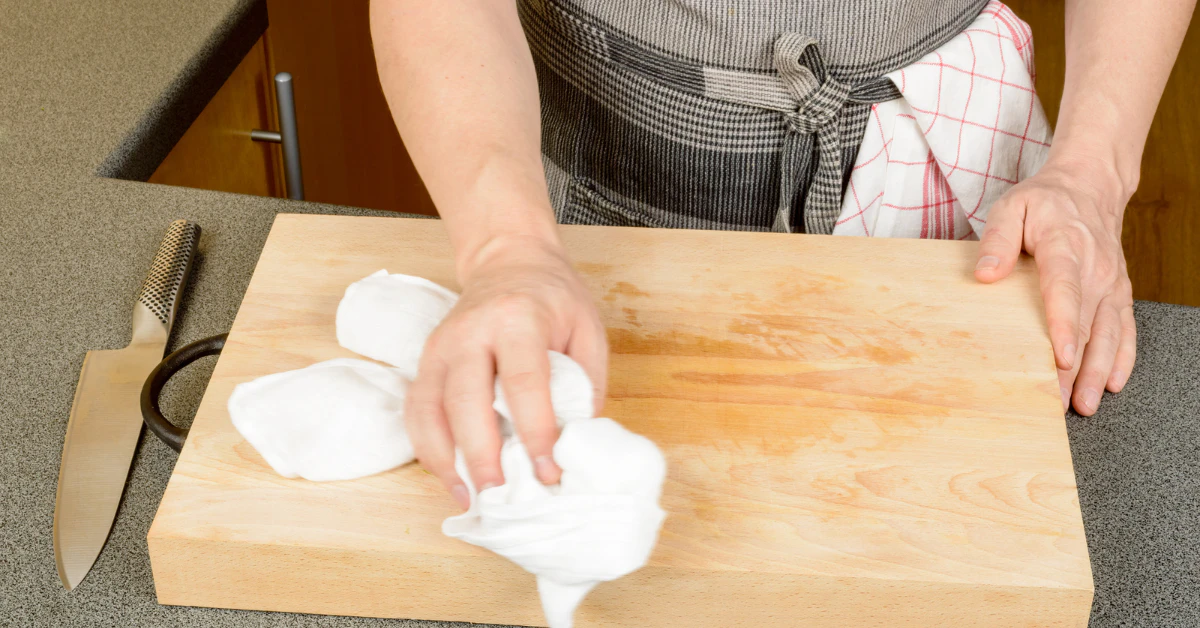
- Wash the board with hot, soapy water right after use. Scrub both sides.
- Mix the USDA bleach solution: 1 tablespoon unscented liquid chlorine bleach per gallon of water.
- Flood the surface with the solution. Let it stand for several minutes.
- Let the solution drain off, then flip the board and treat the other side the same way.
- Rinse the whole board with clean water.
- Dry it right away with paper towels, then stand it upright or prop it up to air dry fully.
Never soak or submerge a wood cutting board in water or bleach solution. Letting it sit in liquid causes the wood to warp and crack over time. Flood the surface, let it stand, then rinse. Don’t let it sit in a sink full of solution.
How to Disinfect Cutting Board Plastic
Plastic boards have one big advantage over wood: they can go in the dishwasher. The high heat and water pressure give them a thorough sanitizing that’s hard to match by hand.
For everyday cleaning:
- Wash with hot, soapy water, or run it through a full dishwasher cycle.
- For extra protection after raw meat, follow up with the USDA bleach solution: 1 tablespoon unscented liquid chlorine bleach per gallon of water, flooded on the surface for several minutes, then rinsed.
But plastic has a weak point. Every time you cut on it, your knife leaves tiny grooves behind. Over time, those grooves get deep enough to trap bacteria where soap and water can’t fully reach. Once a plastic board has heavy knife scarring, cleaning it by hand won’t cut it anymore. At that point, it’s time to replace the board, not keep sanitizing it.
Natural Methods: Do Vinegar and Lemon Actually Work?

Lemon and vinegar get a lot of credit online as natural disinfectants. The real picture is more complicated.
Start with lemon and salt. This combo is genuinely great at pulling out odors like garlic and onion, and it works well for lifting stains. But there’s no clinical data showing it kills bacteria at a reliable rate. Think of it as a cleaner and deodorizer, not a sanitizer.
Vinegar has more research behind it, and the results come with limits. One study found that undiluted vinegar does significantly reduce bacteria counts on a cutting board, but not down to levels considered safe for human exposure. Another study found that vinegar only matches bleach’s effectiveness against E. coli and Listeria when it’s heated to 150°F and used while still above 130°F. At room temperature, vinegar only worked against Salmonella, and only after sitting on the surface for a full 10 minutes.
So if you’re using vinegar, heat matters. A cold splash from the bottle isn’t doing the same job as bleach.
Never mix hydrogen peroxide and vinegar in the same container. This combination creates peracetic acid, which is corrosive and unsafe to use on skin or surfaces.
Frequently Asked Questions
How long can bacteria live on a wood cutting board?
In recent testing, Salmonella was only detectable on wood for up to 2 hours, compared to up to 4 hours on plastic and glass boards.
What is a safe food-safe disinfectant for a cutting board?
The USDA-backed method is a solution of 1 tablespoon unscented liquid chlorine bleach per gallon of water. Flood the surface, let it stand several minutes, then rinse.
Can you use Clorox wipes on a wood cutting board?
Only if the wood is finished and sealed. Clorox wipes are not recommended for unpainted, unfinished, unsealed, waxed, or oiled wood, which describes most home wood cutting boards.
Does vinegar sanitize cutting boards?
Only partly. At room temperature, vinegar only showed strong results against Salmonella, and only after 10 minutes on the surface. To match bleach against E. coli and Listeria, it needs to be heated to 150°F.
What is the best way to sanitize a cutting board?
Wash with hot, soapy water first. Then apply the USDA bleach solution, let it stand, and rinse. This two-step method works for both wood and plastic.
What do Japanese use for cutting boards?
Hinoki wood, also called Japanese cypress, is the most common choice in Japan. It’s valued for being gentle on knife blades and naturally resistant to moisture and bacteria.
Which is the healthiest cutting board to use?
No single material wins outright. Lab testing found that bamboo boards show antibacterial properties, and that wood, plastic, bamboo, and composite boards all came back essentially bacteria free when properly washed. Consistent cleaning matters more than the material itself.
What does Gordon Ramsay use as a cutting board?
He’s widely reported to use a John Boos wood block board. This is based on multiple secondary sources, not a direct quote from Ramsay himself.
Why do chefs use plastic cutting boards?
Plastic boards can go through high-heat dishwasher cycles, which gives a deep sanitize that’s hard to match by hand. Many commercial kitchens also require NSF certification, a standard that confirms a board meets food safety requirements.
Conclusion
Keeping a cutting board safe isn’t complicated once you know the real steps. Wash first, then sanitize with the USDA bleach ratio: 1 tablespoon unscented liquid chlorine bleach per gallon of water. Use separate boards for raw meat and for produce. Skip the shortcuts that sound natural but don’t have the data behind them, like cold vinegar or a quick wipe with the wrong kind of cleaning cloth. A few extra minutes after each meal is all it takes to keep your kitchen, and your family, safe.